
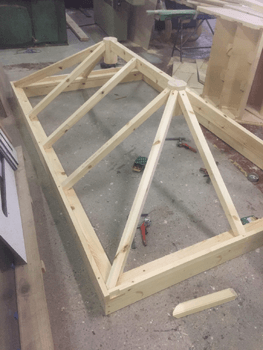
The job: This week begins a new two-part series on the replacement of an antique cupola for an existing customer.
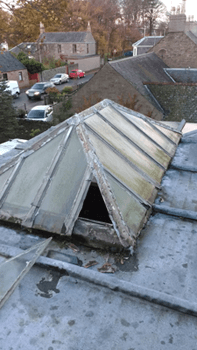
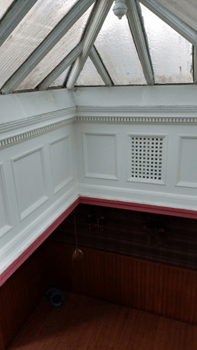
Our approach: Originally, the customer's intention was to keep the cupola, it being such a beautiful feature.
However, when our team surveyed it, we found it to be in a poor state of disrepair. As can be seen from the pictures above, one pane was broken, and the structure was leaking and suffering from rot and severe weathering.
When we reported back to the client, it was agreed we would create a new one which replicated the original as faithfully as possible.
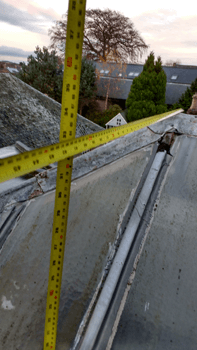
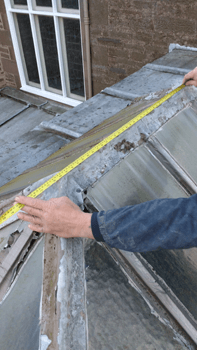
Onsite measurements of the cupola were taken and returned to the workshop, where a joiner used them to handcraft the individual components. These were manufactured from European red wood, which would be metal-capped on the outside for protection from the Scottish weather.
We then assembled the structure of the new cupola piece by piece. Beginning with the base frame, we then erected the two hipped ends, before attaching the ridge piece, as seen below.
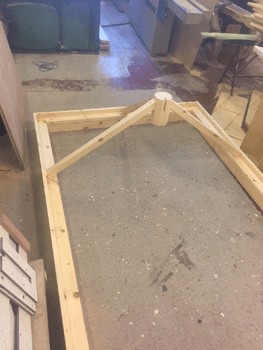
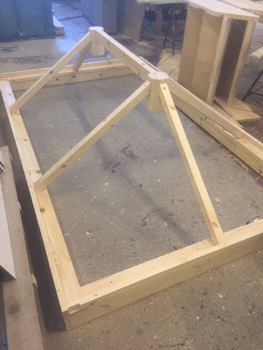
With the central architecture in place, we then added the intermediate rafters to create the traditional look of the original cupola.
Then as a final finishing touch to the wooden structure we added the two underside finials, hand-turned on our lathes, as shown in our Instagram share below (follow us on Instagram to get all of our showcase works!).
We hope you'll join us for our next part, where we'll be taking you from this stage through to the final installation of the cupola, which we consider to be indistinguishable from the original.
What our joiner said:
It's always a pleasure to be asked to help retain the character of a period building, and we take pride in our ability to employ the same traditional skills and attention-to-detail as the original craftsmen.
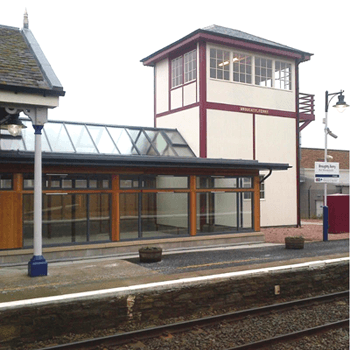
The Job: Opening on the Dundee and Arbroath Railway in 1838, Grade A listed Broughty Ferry is now Scotland’s oldest railway station still in operation. In recent decades the station had grown derelict, and would have been demolished had it not been for an impassioned campaign by the local community and its council to save it.
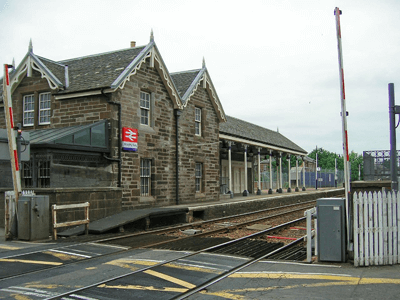
As a part of a comprehensive renovation, we were contracted to take care of the station windows. This included the iconic signal box, a cherished local landmark dating from 1887, which was moved along with all its old levers to a new location during the works.
Our Approach: Working on a functioning train station near a live railway line was the main challenge, requiring works to be boarded off so as not to interfere with day-to-day services.
The Victorian station's old sash and casement windows were in a sorry state. These were removed and brought to our Doune workshop for careful patching and renovation.
Sadly, the signal box windows and doors were beyond repair, but our joiners and glaziers were able to manufacture and fit new ones to precisely match the style of the originals.
At the same time, we fashioned a modern style of window for a later platform building, which was getting revamped to host a new restaurant. This is visible in the Instagram picture below next to the handsome repositioned signal box..
We feel very privileged to have played our part in restoring so precious a piece of our Scottish heritage.
What the Planning Secretary of Broughty Ferry Community Council said:
The station looks very attractive now and it is much better than having the whole thing demolished. If you knock down all the old things that give you a sense of place you lose a lot of the local character of the area. Hopefully now when people pass by on the train they will see it and think to stop here
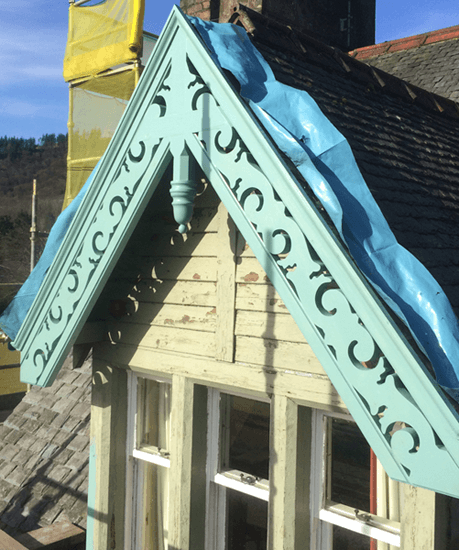
The Job: A house in a local National Park (Loch Lomond and The Trossachs) needed to replace some ornate Victorian fascias. These were heavily-weathered, rotten and potentially dangerous. Due to being in a conservation area, the new fascias needed to be in keeping with the design of the old.
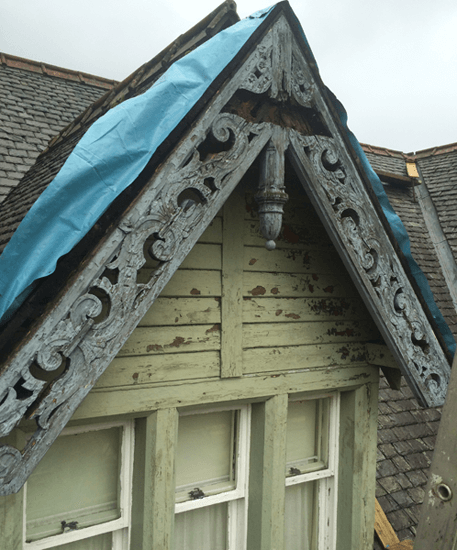
Our Approach: We removed a sample of the fascias’ repeated pattern and brought it back to our workshop in Doune. There, our joiners employed tried and tested methods to create a template, which we then used to carve exact full scale replicas of the originals.
Fitting the new fascias was tricky due to the high roof and the house being very close to a main road, but the scaffolding was sufficient for us to complete the work.
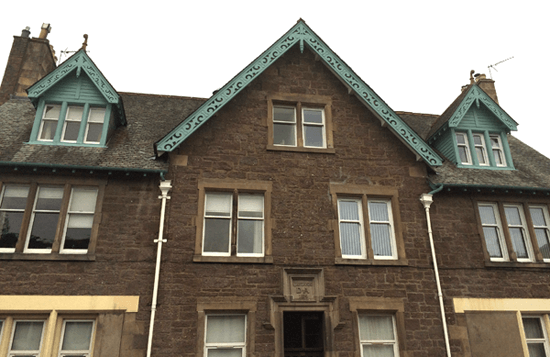
We’re proud of our achievement, which is a mark of our respect for those local craftsmen who carved the beautiful originals. We hope our successors will treat our own work the same way when the fascias come round to their next refit a century-or-two in the future!
What the customer said:
It was a challenging job and we’re grateful Key Square were prepared to take it on and for their beautiful craftsmanship!
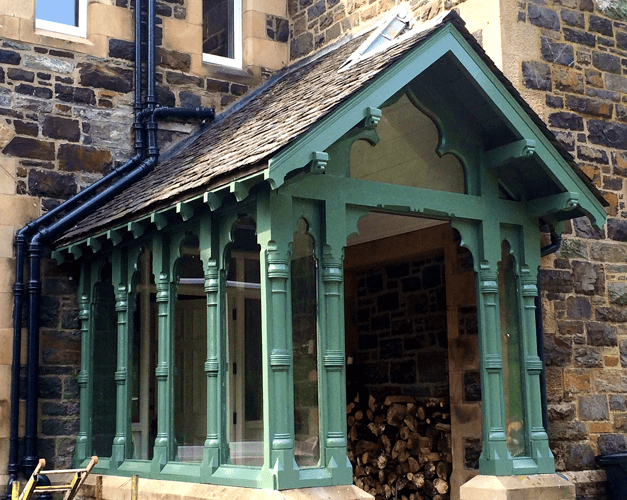
The Job: Our customer had fallen in love with a beautiful house and its gorgeous surroundings, located in a scenic national park. He called upon us to assist with some restoration work, and was passionate that this should be as honest as possible to the original design.
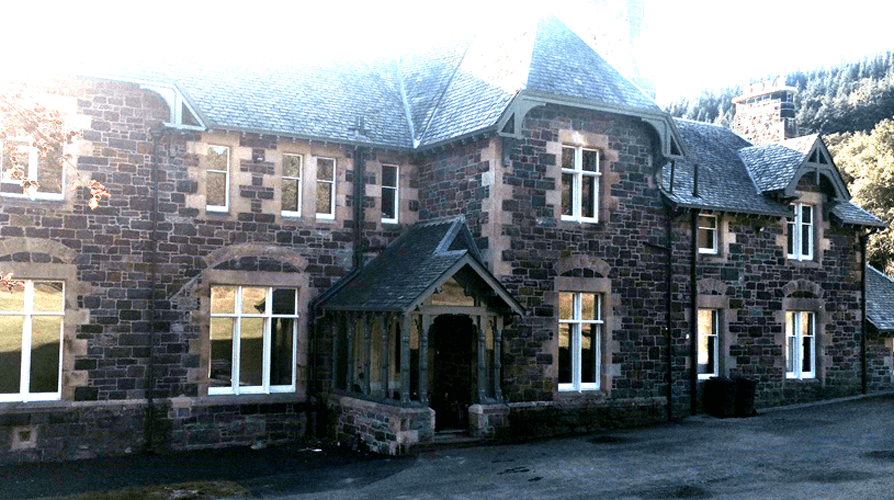
After replacing the house’s ninety sash-and-case windows, we were asked us to restore the porch to its former glory. An unattractive extension had been added to the original, serving perhaps as a cloakroom, the building having served previously as a respite home for a local church and a B&B.
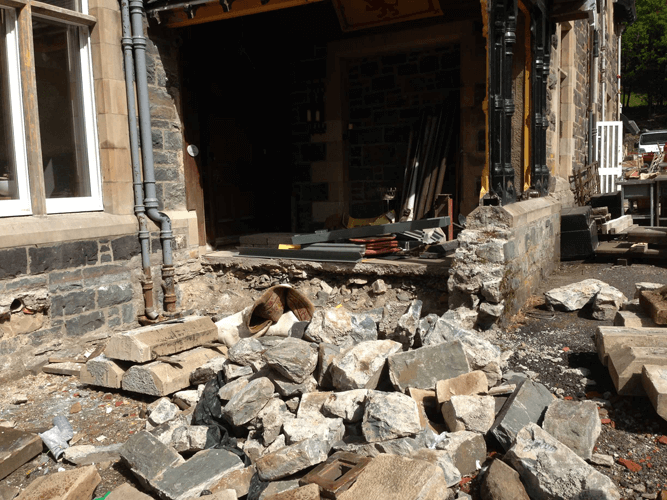
In the picture above, the remains of the extension can be seen. This shows the stonework and window which had replaced the original entrance and steps, and a sash-and-case window which had looked out on the interior of the extension.
Our Approach: The job was quite a jigsaw puzzle! Luckily, the customer possessed a black-and-white photograph of the house pre-extension sufficient for us to ascertain the design of the original porch. He had also found the porch’s original columns, although these were in a poor state (see picture below).
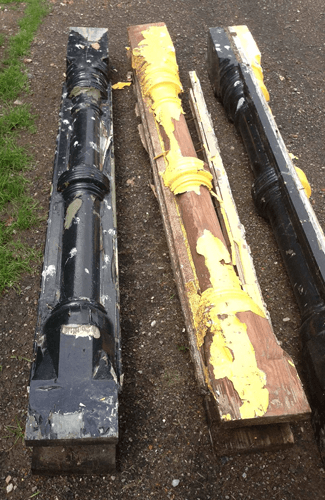
The porch’s original stonework had been incorporated into the extension, so we were also able to reclaim this from the downtakings.
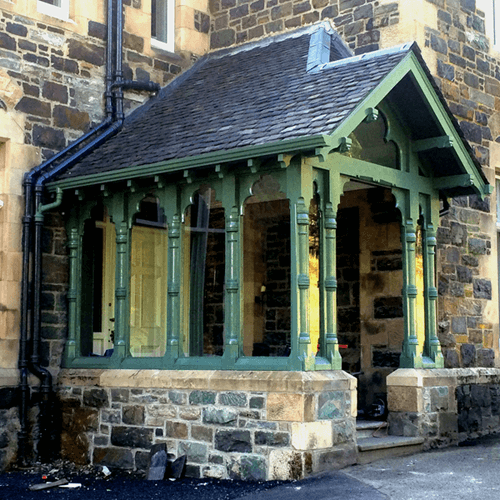
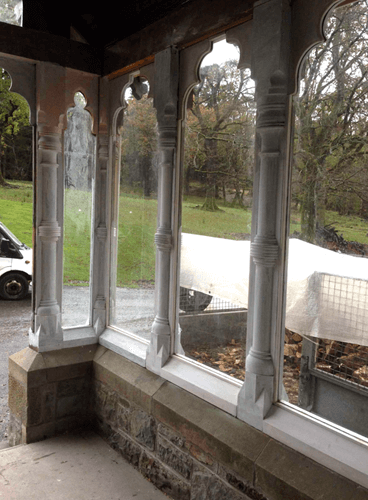
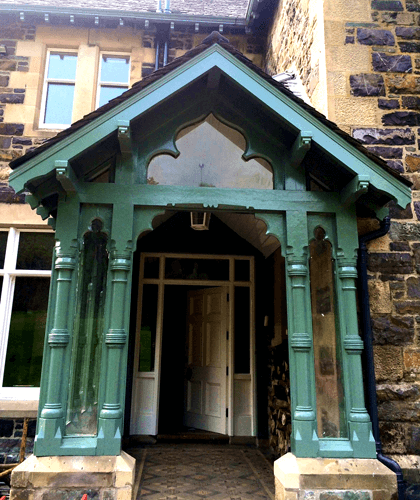
From these parts, and referring to the old photograph, our team then spent a week reconstructing the glorious original porch, some pictures of which appear above and below. Follow Keysquare on Instagram to get pictures of our artisan teams' finest works!
What the customer said:
I was passionate that the porch should be a completely faithful restoration, and with Key Square’s skills, this has been wholly realised!
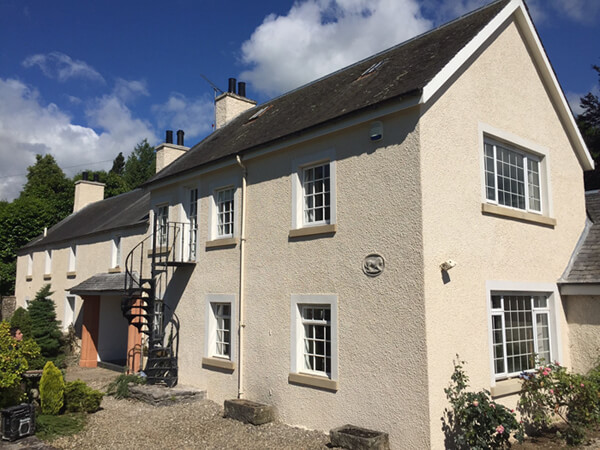
The Job: Existing customers called us having noticed the render on the front façade of their house had developed some cracks. They suspected some water might be penetrating around the sill of one of the gable windows.
Our assessment suggested the cracking could have been patched and the sill replaced. However, our preferred approach, and the customers’, was to remove the existing render, perform a thorough inspection of the underlying brick and stonework, and then reharl the front and side façades and chimneys.
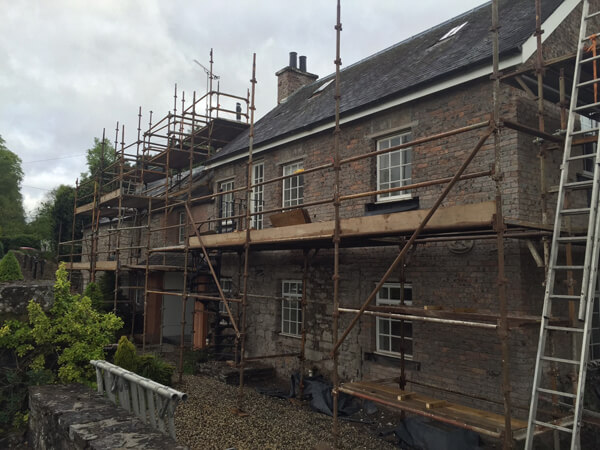
Our Approach: First we stripped back the façade to the bare bones, an underlying combination of brick and stone - a legacy of an old extension to the original house.
We then applied a wire mesh system to the whole face, and covered the cracks and joints between the stone and brick. We also replaced the concrete windowsills with natural stone, as they would have been when the house was first built.
The trickiest part of the whole job was removing the heavy old sills without damaging the windows, which required scaffolding for the walls and chimney. One of the windows needed replacing, so our joiners crafted a bespoke match in our workshop.
Finally, we tidied up the windows, and applied a natural coloured product to the façade for the overall finish. Our customers are delighted that their new finish is maintenance free, as opposed to the old one, which required periodic painting for upkeep.
What the customer said:
We feel we were given very sound advice by Key Square and are delighted with the end result. Without exception all involved on and off site were friendly, helpful and committed to achieving a good result for us